


RADIATOR FAILURES

Causes of radiator failure Premature failure will usually occur due to pitting corrosion although this will have a wide range of causes. Commonly, oxygen pitting, chloride induced pitting and pitting associated with copper plating are found. Pitting usually occurs at areas of natural stress, i.e. convex folds or near welds which are anodic sites in the radiator. Manufacturing defects are rare but where found are commonly associated with welding defects.
New radiators fitted to old systems are anodic to the system and are prone to premature failure. Old radiators may eventually fail due to under deposit corrosion associated with sludge deposits, usually magnetite (Fe3O4), at the bottom-centre of the panel, which causes pitting corrosion in the absence of any specific fault with the water or system. In most radiators sludge accumulation causes blockage, or inefficiency, long before the radiator leaks.
Manufacturing defects Whilst manufacturing defects are rare, problems associated with welding are occasionally seen. Most notably, failures occur where oil residues are present within radiators and welding causes the carbon from the oil to form carbides in the weld, weakening it and promoting pitting corrosion. Paint may be found in older radiators but today the tappings are capped to prevent such an ingress. A layer of paint may promote under deposit corrosion even though the deposit itself is inert.
Oxidic corrosion Oxidic corrosion is highlighted by the presence of red-brown ferric iron oxides, Fe2O3.xH2O, and results from aeration faults on the system. Aeration may also lead to high rates of evaporative loss causing the accumulation of chloride and sulphate, which promote pitting. The presence of carbonate scale can indicate leaks have occurred in the system and these will also have introduced oxygenated water into the system. Black magnetite iron oxide, Fe3O4, indicates that the system does not suffer from aeration.
The effect of flux residues Where a high chloride concentration is found in the system water but the sulphate level is comparable to the mains water, the presence of flux residues may be suspected. A disrupted layer of metallic copper may be deposited electrochemically onto the surface of radiators in systems contaminated with flux residues although the same effect may be seen wherever dissolved copper levels are high. It is the action of self-cleaning fluxes which remove copper oxide from the surface of pipes during soldering that can lead to radiator failure through copper plating. Excessive use of the flux rather than the differences between brands is the ultimate cause of the problem. Often the copper plating can be seen to have been deposited at cathodic areas of the radiator for example, at concave folds and flat areas.
Pre-commission cleansing in accordance with BS7593:1992 and Benchmark is strongly recommended for all new installations.
Other causes of premature failure In areas of excessive flow rates there may be erosion corrosion which produces broad shallow regions of thinning quite unlike corrosion pits. This damage is often associated with aeration faults. Ferric oxides are more soluble than magnetite and are quickly removed from the surface to expose new material.
If hydrogen sulphide is present this may be indicative of the presence of sulphate reducing bacteria (SRB’s). These bacteria may cause corrosion directly but are only active during periods of summer shut-down. There are, however, mesophillic and thermophillic SRB’s which can survive and grow in hot water. Remedial action Where pin-hole perforation of radiators has occurred due to corrosion it is likely that all other radiators in the system will be similarly affected. It is therefore usual to recommend that all radiators are replaced.
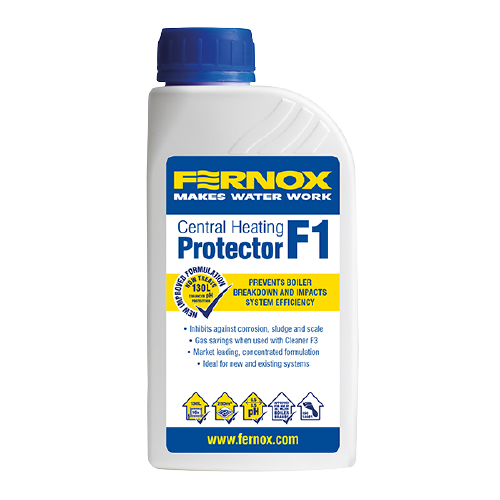
Strong de-scaling with acid descalers is not recommended on systems where radiator failure has occurred unless it is the intention to expose any latent weaknesses. Mild cleansing with a dispersant type product, such as Fernox Restorer, is usually necessary to remove corrosion products that could ingress into replacement radiators.
Remedial action to eliminate aeration faults such as pumping over is essential if repeat failures are to be avoided.
|